Wednesday, February 15, 2012

Flight of the Paladin


A brave and stalwart paladin riding his steed into battle against a rampaging fire breathing dragon! The classics are always the most fun.

This recent project made for an excellent example of my process and I thought I would share some of that with you.

For a full, streaming evolution watch the painting unfold on video:


©2012 William O'Connor Studios

Monday, January 16, 2012

Varnishing Day

As we all know the deadline for entries into Spectrum: The Best in Contemporary Fantasy Art is coming up fast. I just got my entries off today. I am a huge fan of this publication, have been in it many times and think it is a showcase of some of the best artists of our generation. That said, there has developed an almost mythological quality to this annual. Artists rushing about frantically trying to get work finished before the deadline, sleeplessly going over what to submit, what to leave out, then waiting with bated breath to see if they got in. Careers have been made in Spectrum. At the same time there are artists who refuse to enter. They feel it is too political, too random to place that much credit upon a small group of subjective jurists.

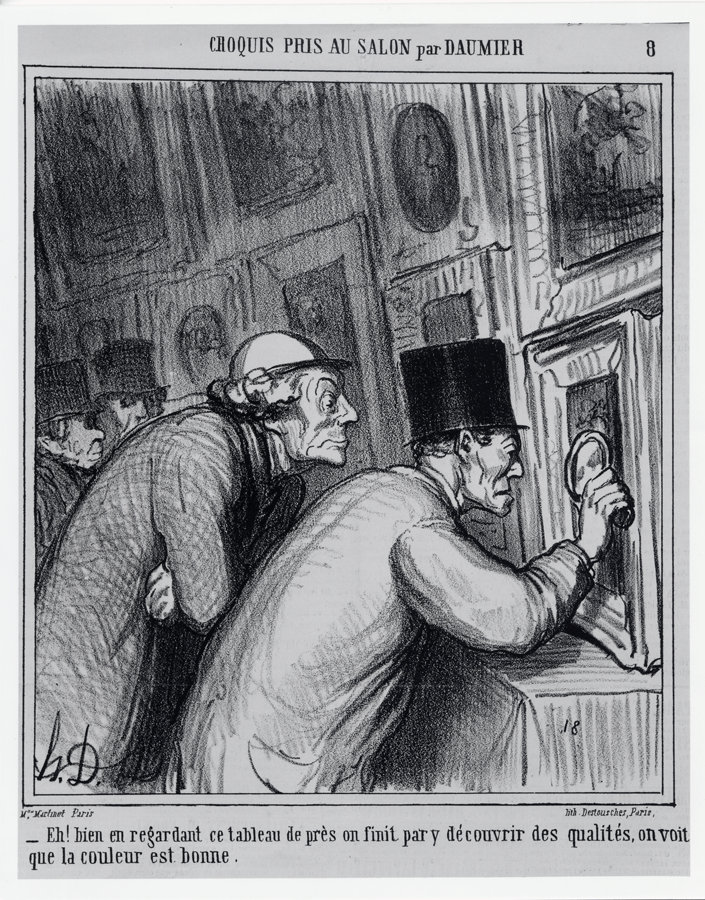
Whatever side of the fence you fall on, this time of year always reminds me of Varnishing Day. Varnishing Day was the most important day in the artistic calendar of the Academic Salon artist. It was the last day that artists could make final alterations to their work before the Salon would open to the public and the judges would cast their ballots. The entire year for an artist came down to this one show! If you got in and won an award it would make your year in sales and commissions. If you won the Grand Prix it would make your career! The better you did at the show the better your sales, the better your sales the more students you got in your workshops. The more students you got the better your print sales and the better you would do in the show next year, and around and around. This academic salon system became so ingrained in the culture that to be an artist you could not work outside the academies. Famous artists like Manet and Delacroix bristled at the Salon System, but tried to work within it. By the late 19th Century the younger generation of artists had had enough of the politics and began to display their works in alternative shows.

In 1873 a group of Franco-Prussian War veterans and conscientious objectors who had fled to England returned to Paris and were refused entry into the Salon. Being a bunch of twenty-something post grads who didn't know any better they got together, rented some cheap space and put on their own show. That group included Pissaro, Monet and Degas among others. This group sardonically called themselves The Refused, but were ridiculed by the establishment as The Impressionists. (This could be likened to being called The Doodlers, today.)

This revolution of individual artist's freedom to work outside the academy and the academy's standards changes art forever. By the end of the 19th Century the academic salon system had grown so big and political that it could not evolve with modernity, and like the dinosaur it was, went extinct. In 1893 one critic reviewing the art salon at the World Columbian Exhibition in Chicago containing the works of such Victorian luminaries as Bouguereau, Leighton and Waterhouse remarked, "This exhibition has done more to set back the advancement of art than any event in the past twenty years."

In 1913 The New York Armory Show would seal the coffin on the Victorian Salon System and give way to the twentieth century modern Gallery System. An exhibition by artists and for artists. You can see by the poster left that the artists are referred to as "guests", this was a private invitational exhibit, not a state funded juried show. Instead of paintings shoehorned together like a patchwork,"salon-style" each painting would be displayed by itself, "gallery-style". Instead of one huge institutional juried show there would be hundreds of little independent private shows run by the artists themselves. Each small "ism" could find its own niche, and its own followers. These would become the model for today's successful trade shows like Comic Con and Illuxcon.

In the 21st Century this evolution has continued. The Gallery System is now under threat by artist-run websites. Today artists do not even need the galleries or publishing houses gathering millions of followers on-line circumventing the exclusivity of the galleries. Today there is a venue for any kind of art you can imagine and you can follow along directly with the artist. Whether this is a better system is arguable. A direct Democracy of Art where page views and followers equates to quality, or is there still a role for the juried show in contemporary art? Check back in a hundred years and I'll tell you how it turned out.

So this week as you put the final touches of varnish on your painting for selection in the Spectrum Show lets all remember how far we've come, and where the future may take us!

Enjoy.

WOC

Thursday, December 29, 2011

Artist of the Month-Franz Kline

In my continuing Artist of the Month series I routinely try to explore artists outside of the Fantasy genre that have influenced my work or inspire my work tangentially through their unorthodox process. This month I expand upon this idea by including one of my favorite artists Franz Kline (1910-1962).

As a fantasy artist it would seem that there is very little connection between the high modern Abstract Expressionist and myself, but he is one of the few painters who's work I keep hanging on my wall in my studio. Kline is the ultimate composer. When ever I begin a work in the thumbnail stage I, (and every artist) should look to Kline. Eliminating narrative, eliminating color, eliminating space, Kline works in pure abstract composition. Influenced by Asian character brush painting Kline takes the pure form of the thumbnail sketch and elevates it to high art. The essence of the creative process.

There is not much to say about his work.  It is what it is.  Pure and clean and sublime. There is no context or narrative, simply the essence of painting. I have always admired his compositions and he is the master of the thumbnail. So the next time you are struggling in your sketchbook over a dozen preliminaries, look to Kline and draw inspiration from the master who spent his life executing thousands of paintings dedicated to this simple and limitless exercise.

Enjoy.

WOC

Friday, December 16, 2011

Clothes vs. Costume

I had a professor once that told me that there was a difference between clothes and costumes. Costumes are what people wear when pretending to be someone they're not, while clothes are the items we wear every day.

In fantasy character design I am constantly trying to balance the practical with the fantastical. As in any other type of design form needs to follow function. When designing the garments and gear of a character in a fantasy game that will be in combat situatons and traveling to different environments and locations, I always like to refer to actual soldier gear. The past 150 years has allowed us to take candid photo reference of what soldiers actually wear into battle. Although the technology has changed over the past several thousand years, the soldier's gear has altered little.

In this photograph (ca. 1863) we see soldiers preparing for rail transport to the front. Whats noticeable is how little they carry. A small ruck sack, ammunition case and rifle. This was a direct example of form following function. 19th C. soldiers never traveled far from their supply lines and a regiment would be accompanied by camp followers and even family that would cook and make camp.


In this WWI photo taken fifty years later we see how soldier's gear has evolved. Notice that there are no backpacks. Trench warfare had ground movement to almost zero. A soldier's primary concern was protection against machine guns. These German soldiers have sacrificed all their weight allowance to armor. The high leather boots and leggings were to protect them from standing and sleeping in the mud for weeks.


In WWII, only thirty years later, the style and technology of warfare has evolved again. Warfare and combat become extremely mobile. A soldier must carry everything he needs to last for an entire mission inside enemy territory. If you can't carry it, you don't have it. Its this form following function that we see almost all armor (except the helmet) abandoned in favor of mobility and all weight allowances are surrendered to ammo pouches and gear. The entire body becomes a backpack.

In Vietnam the rule of form following function changes again. Mobility is of crucial importance, but soldiers were closer to supply lines with the use of helicopters and fire support bases. Supplies could be sacrificed to more important needs, like armor and ammo.


Today the contemporary soldier is no different that anytime in the past 5000 years. In the middle east we see new armor styles evolving. Armored vests, elbow and knee pads, as well as eye protection are essential for urban close-quarter-combat. Shattering glass and broken concrete have replaced shrapnel as threats. With no need for long marches backpacks have been replaced by water pouches. The soldier's gear is tightly packed around the torso in order to maintain balance in the rough terrain. and to move in tight quarters easily. With close supplies and support their are almost no personal supplies carried on patrol. The new warfare has also introduced female soldiers into the equation. So what does female armor look like? Its exactly the same as male armor. The US Army frowns upon kevlar bikinis.


So although as a fantasy artist I am not trying to replicate historically accurate armor I hope this shows is that we can all draw a great deal of reference from actual soldiers and combatants. The fact is that a soldier will only wear what she absolutely needs. If it does not serve a function its abandoned, and its appearance is of no concern to them. This gear is what keeps them alive. When designing characters of my own, I continually try to remember, what would this person wear to keep them alive today? I try to design clothes and not costumes.

Enjoy.

WOC

Monday, November 28, 2011

Champions of the Heroic Tier

Thought I would share a cover I did for Wizards of the Coast. Champions of the Heroic Tier (Wizards of the Coast 2011) I'm including my original thumbnail and the final cover. Fairly self explanatory, but a fun painting, lots of fiddly bits and action!

Enjoy.

WOC


Friday, November 25, 2011

Artist of the Month- Prokofiev (Peter and the Wolf)

This month I am inspired by my daughter's interest in Peter and Wolf by Sergei Prokofiev (1891-1953). Listening to the New York Philharmonic production my daughter was enthralled by the audio and developed a whole narrative in her mind. Trying to watch the Disney version she was disturbed that the story did not follow her imagination and I quickly disposed of the rendition to allow her to imagine the story in her own way. I thought that this would be a great concept-art learning moment for students and artists to interpret the music in their own way. Attached is the audio for the Leonard Bernstein , New York Philharmonic Production of Peter and the Wolf (1960). I encourage you all to listen and interpret the story your own manner...


Listen:
Peter and the Wolf-Bernstein

WOC

Wednesday, November 16, 2011

Battle Cleric Redux

After my last post I decided that it might be fun to revisit my twenty year old character of the Battle Cleric. Its twenty years later and the bearded priest has leveled-up more than a few times. His adventures have left him scarred but wiser....aren't we all.

A battle hardened veteran, and still a bad-ass undead killer.

Enjoy.

WOC


"Battle Cleric Redux"
6"x9" digital
©2011 William O'Connor Studios


"Battle Cleric"

9"x12" pen and ink
©1991 William O'Connor Studios